


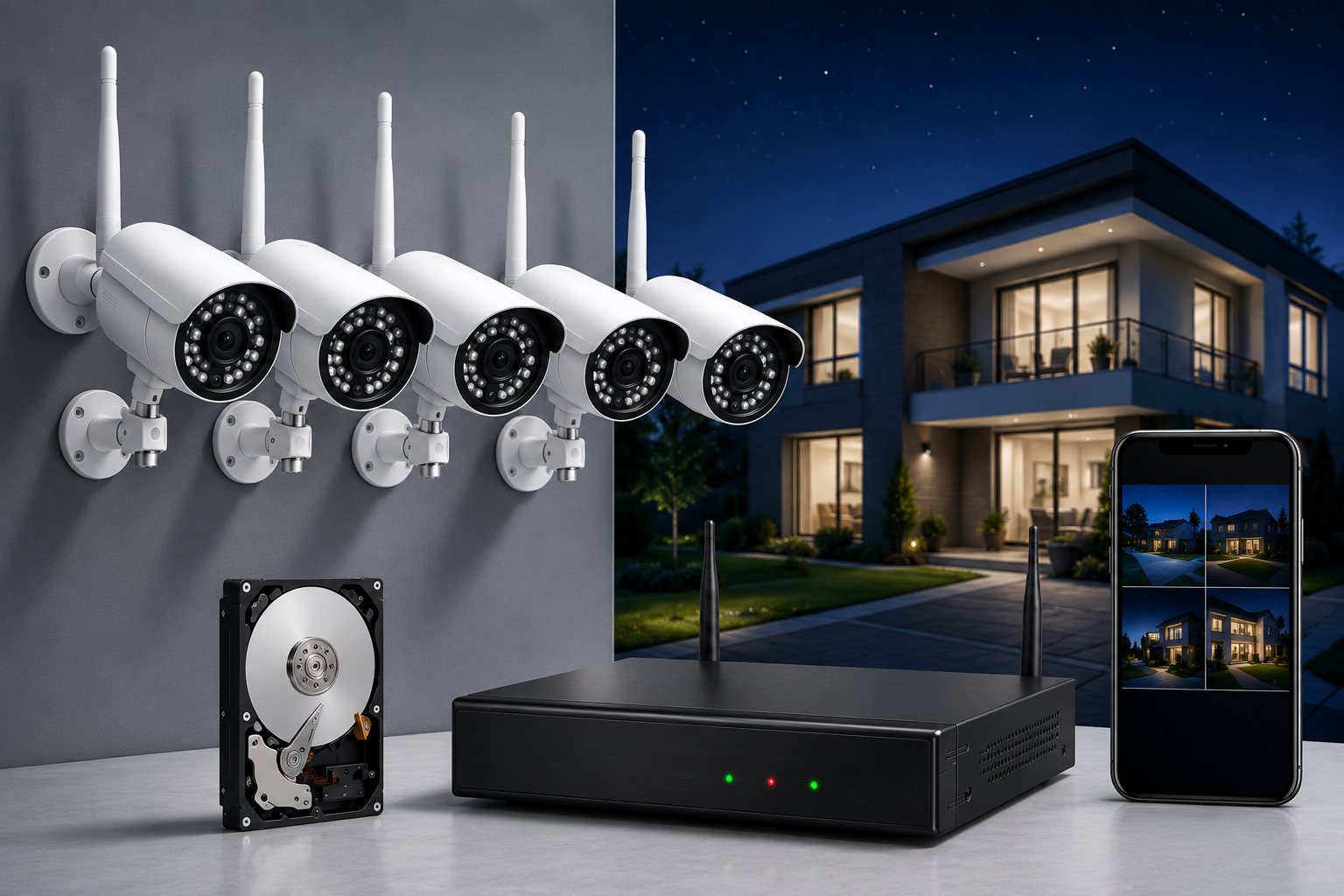

Security is becoming a priority for homes, offices, shops, warehouses, and other properties. A wireless CCTV camera with night vision recorder is a convenient surveillance solution that allows you to monitor your property during both daytime and nighttime.
Unlike traditional wired CCTV systems, wireless cameras can offer flexible installation with fewer cables. When combined with night vision and a recording device, they can provide continuous security monitoring and recorded footage when you need it.
A wireless CCTV camera uses a wireless network to transmit video footage to a recording device, monitor, smartphone, or other connected system. The night vision feature allows the camera to capture images in low-light or dark conditions.
A recorder, such as an NVR or compatible storage system, can save the recorded footage for later viewing.
A typical system may include:
Wireless CCTV cameras capture video and transmit it through a wireless network to the recording system or connected device.
The basic process is:
Camera → Wireless Network → Recorder → Storage → Mobile/Monitor Viewing
Users can access live footage and, depending on the system, review previously recorded videos from a smartphone, computer, or monitor.
One of the biggest advantages of wireless CCTV cameras is flexible installation. Since video transmission does not require a dedicated video cable between every camera and recorder, installation can be easier in suitable locations.
However, most wireless cameras still require a power source unless they are specifically designed as battery-powered cameras.
Night vision is an important feature for security cameras. It allows cameras to capture footage when there is little or no visible light.
Depending on the model, night vision may use infrared technology to produce usable footage in dark environments.
Many modern CCTV systems allow users to view their cameras remotely through a smartphone application. This can be useful for monitoring homes, businesses, offices, and other properties while away.
Wireless connectivity provides greater flexibility when positioning cameras. This can be particularly useful in locations where running long cables is difficult.
When connected to a suitable recorder and storage drive, the system can save surveillance footage. Recorded videos can be useful for reviewing incidents or checking activity around a property.
A camera alone may provide live monitoring, but a night vision CCTV camera with recorder provides an additional layer of security by allowing footage to be stored.
A recorder can help you:
The amount of footage you can store depends on factors such as camera resolution, number of cameras, recording settings, compression technology, and hard-drive capacity.
Both wireless and wired CCTV systems have their own advantages.
| Feature | Wireless CCTV | Wired CCTV |
|---|---|---|
| Installation | Generally more flexible | Requires cable installation |
| Cabling | Less video cabling | More cabling |
| Camera placement | Flexible | Depends on cable routes |
| Network dependence | Usually higher | Generally lower for video transmission |
| Expansion | Can be convenient in suitable networks | May require additional cabling |
| Reliability | Depends on wireless signal | Generally consistent connection |
The right choice depends on the property layout, network quality, installation requirements, and security needs.
A wireless CCTV camera with night vision recorder can be used in many locations, including:
Before installation, make sure the camera provides adequate coverage of the areas you want to monitor.
Before purchasing a wireless CCTV system, consider the following factors.
Higher-resolution cameras can provide more detailed footage. Choose a resolution appropriate for the distance and area you need to monitor.
Check the manufacturer's stated night vision range and consider whether it is sufficient for your property.
Choose an appropriate recorder and hard-drive capacity based on the number of cameras and how long you want to retain recordings.
The camera should maintain a reliable wireless connection with the network. Walls, floors, distance, and other obstacles can affect wireless performance.
Motion detection can help reduce unnecessary recordings and make it easier to identify activity.
If remote monitoring is important, look for a system that supports secure mobile viewing.
For effective surveillance, camera placement is extremely important.
Install cameras at locations that provide a clear view of:
Avoid positioning cameras directly toward strong light sources, as this can affect image quality. Also, make sure the wireless signal is strong enough at the installation location.
A wireless CCTV camera with night vision recorder can be an effective security solution for homes and businesses. Wireless connectivity offers installation flexibility, while night vision helps provide surveillance in low-light conditions. Adding a suitable recorder also allows important footage to be stored and reviewed later.
Before choosing a system, compare camera resolution, night vision range, wireless connectivity, storage capacity, motion detection, mobile access, and installation requirements. Choosing the right combination of features can help create a reliable CCTV setup for your security needs.
It is a security camera that transmits video wirelessly and uses night vision technology to capture footage in low-light or dark conditions.
Yes. Cameras equipped with night vision can record in dark conditions, depending on their specifications and available lighting.
Most wireless CCTV cameras still need a power source. Some models are battery-powered, while others use a wired power connection.
Many modern CCTV systems support mobile applications that allow users to view live footage and, depending on the system, recorded videos remotely.
Storage duration depends on the hard-drive capacity, number of cameras, video resolution, frame rate, compression, and recording settings