


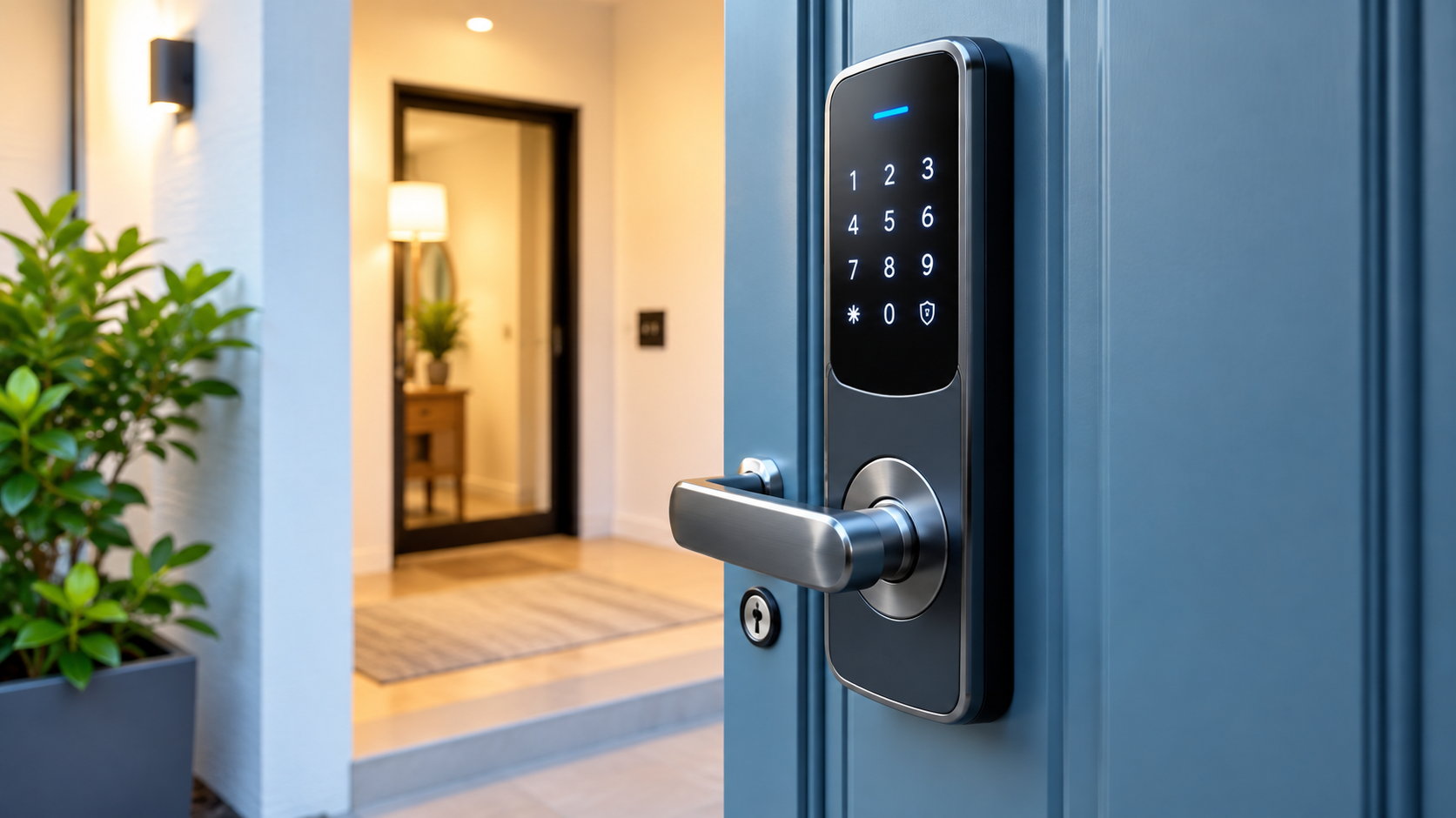

A smart door lock is becoming an important part of modern home security and home automation. Unlike traditional locks that depend only on physical keys, smart locks can provide keyless access through methods such as PIN codes, fingerprints, smartphones, cards, or other authorized access systems, depending on the model.
As smart home technology continues to develop, homeowners and businesses are looking for security solutions that offer both protection and convenience. Smart door locks can help reduce dependence on physical keys while giving users more control over who can access a property.
For homes, offices, apartments, hotels, and other spaces, a properly selected and installed smart door lock can become an important part of a connected security system.
A smart door lock is an electronic locking system that allows authorized users to unlock and secure a door without relying solely on a traditional mechanical key.
Depending on the model, a smart door lock may support one or more access methods, including:
Some smart locks can also connect with other smart home devices. This makes them useful for people who want to integrate door security into a broader home automation system.
The exact features available depend on the lock, installation type, communication technology, and manufacturer's design.
A smart door lock combines electronic components with a locking mechanism. When an authorized access method is verified, the electronic system activates the locking mechanism and allows the door to open.
For example, with a fingerprint-enabled model, the user places a registered finger on the sensor. If the fingerprint is successfully recognized, the lock can authorize access.
Other systems may use a PIN, smartphone application, access card, or another authentication method.
Some connected models can communicate with a smartphone or home automation hub using technologies such as Bluetooth, Wi-Fi, or other supported wireless protocols.
Because smart locks vary significantly, homeowners should check the connectivity, access methods, power requirements, and compatibility before installation.
One of the biggest advantages of a smart door lock is the ability to access a property without carrying a conventional key.
Depending on the model, users may be able to unlock the door using a fingerprint, PIN, smartphone, card, or another authorized method.
This can be particularly convenient for people who frequently forget or misplace keys.
Smart locks can provide greater control over who is allowed to enter a property.
For example, a homeowner may provide an access code to a family member or authorized person instead of giving them a physical key.
In business environments, access can potentially be managed according to employees, rooms, or operating requirements, depending on the system.
Families can benefit from having multiple authorized access methods.
Parents, children, and other household members can use their own approved access credentials instead of sharing one physical key.
This can make everyday entry more convenient while reducing the need for duplicate keys.
Some smart door lock systems support temporary or limited access credentials.
This can be useful when giving access to:
The availability of temporary access depends on the specific lock and its software or access-control system.
A smart door lock can become part of a larger home automation setup.
For example, a connected home may include:
When compatible systems are connected, users can manage multiple aspects of their property through a centralized platform or application.
There are several types of smart door locks available in the market. Choosing the right option depends on the door, security requirements, access preferences, and installation conditions.
Fingerprint locks use biometric authentication to identify registered users.
They can be convenient because users do not need to remember a PIN or carry a physical access card.
Fingerprint locks are commonly considered for homes, offices, and other spaces where convenient individual access is required.
PIN-based locks allow users to enter a predefined code using a keypad.
They can be useful for families and businesses because authorized users can access the property without carrying a key.
Some systems may support multiple codes or temporary codes, depending on the model.
These systems use cards or RFID credentials for access.
They are commonly associated with offices, hotels, apartments, and other environments where access needs to be managed across multiple users.
Some smart locks can be controlled through a smartphone application.
Depending on the model, users may be able to lock or unlock the door, manage access credentials, or receive status information remotely.
Connectivity and remote functions vary by product, so compatibility should be checked before purchase.
Some systems combine multiple access methods.
For example, a single lock may support a PIN, fingerprint, smartphone, and physical key backup.
This provides users with different options depending on the situation.
Traditional locks remain widely used because they are simple and familiar. However, smart door locks provide additional electronic access and management features.
A traditional lock generally depends on a physical key. A smart door lock can offer keyless entry and, depending on the model, additional access-control functions.
The choice between the two depends on the user's needs.
For someone looking for a straightforward mechanical solution, a conventional lock may be sufficient. For homeowners or businesses interested in keyless entry and smart home integration, a smart door lock may provide additional functionality.
Smart door locks are designed to provide controlled access, but no security system should be treated as completely risk-free.
Security depends on several factors, including:
Users should choose products from reliable manufacturers and follow recommended security practices.
For connected locks, strong account passwords and secure network settings are also important. Software and firmware should be updated according to the manufacturer's recommendations.
A physical backup access method can also be useful in case of battery depletion, connectivity problems, or other unexpected situations, where supported by the lock.
Many smart door locks operate using batteries. Therefore, battery management is an important consideration.
Depending on the model, a lock may provide:
Before installing a smart lock, check how the particular model handles low-battery and emergency access situations.
Regularly checking the battery condition can help prevent unexpected access problems.
Before purchasing a smart door lock, consider the following factors.
Not every smart lock is suitable for every door.
Check the door thickness, existing lock mechanism, handle configuration, and installation requirements.
Choose an access method that suits your daily routine.
If multiple family members need access, fingerprint or PIN-based systems may be convenient. If remote management is important, a compatible connected lock may be more appropriate.
If you want smartphone or home automation integration, check whether the lock supports the required connectivity technology.
Do not assume that every smart lock supports Wi-Fi or every smart home platform.
Understand the power requirements and available emergency access options before installation.
Review the authentication, access-management, tamper-related, and software-security features offered by the specific product.
Correct installation is important for reliable operation.
An incorrectly aligned lock can cause mechanical problems even if the electronic components are working correctly.
Professional installation can help ensure that the lock is properly fitted and configured.
Smart door locks are not limited to residential properties.
They can also be considered for:
Businesses may benefit from electronic access management because multiple people may need access to the same property.
For example, instead of distributing physical keys to every employee, an appropriate access-control system can provide authorized users with individual credentials.
The exact access-management capabilities depend on the chosen smart lock and supporting system.
The biggest advantage of a smart door lock can be its ability to work as part of a wider home automation system.
Imagine arriving home and using an authorized smartphone or biometric credential to unlock the door. At the same time, compatible automation systems could manage lighting, security cameras, or other connected devices according to configured rules.
The possibilities depend on device compatibility and the automation platform being used.
This is why it is useful to plan the complete smart home ecosystem before purchasing individual devices.
A smart door lock should ideally work with the other automation products you intend to install.
When installing a smart door lock, avoid these common mistakes:
A lock may have excellent features but still be unsuitable for your existing door.
Always understand what happens if the battery dies or the electronic system becomes unavailable.
Connected smart devices should be protected with strong, unique credentials.
If the manufacturer provides firmware or application updates, follow the recommended update process.
Incorrect alignment can affect both security and daily operation.
A smart door lock can make property access more convenient while adding electronic access-control features to a modern security system. Depending on the model, users can access doors through fingerprints, PINs, smartphones, cards, or other authorized methods.
Smart locks can also become part of a wider home automation setup that includes cameras, sensors, smart lights, alarms, and other connected devices.
Before choosing a smart door lock, consider door compatibility, access methods, connectivity, power requirements, security features, backup access, and installation requirements.