


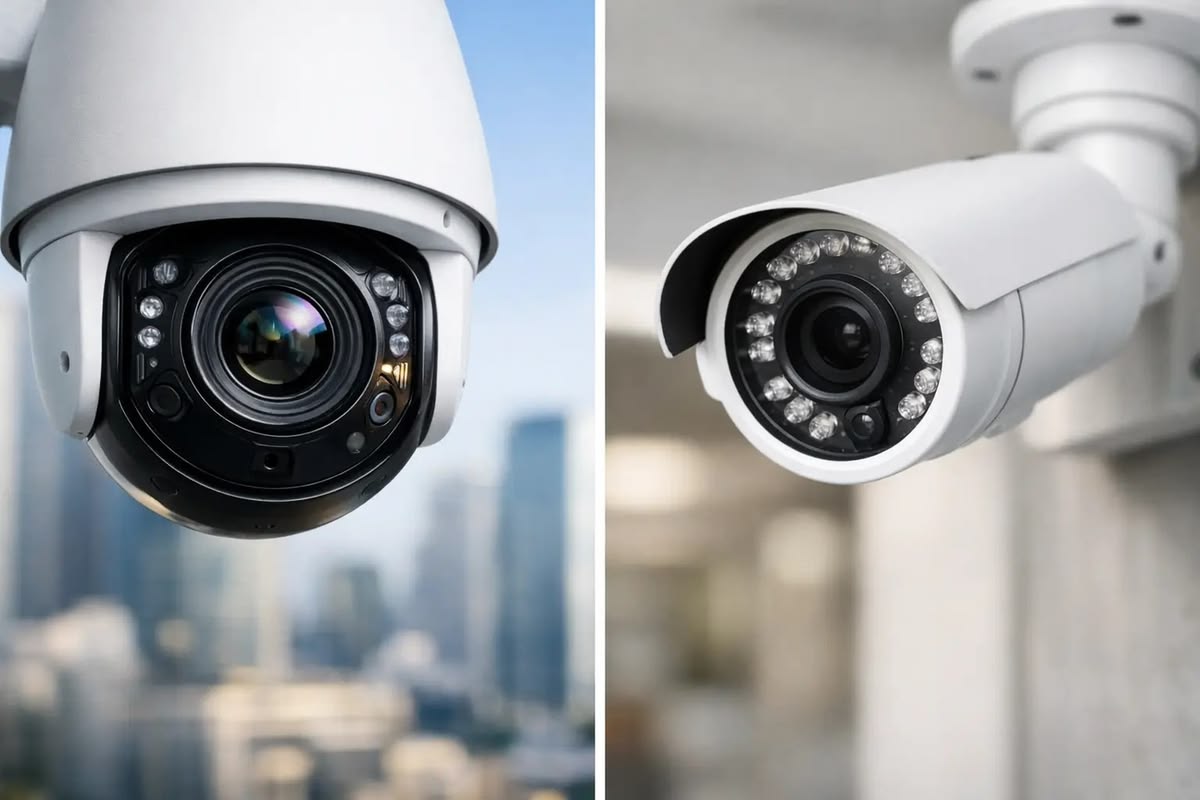

Choosing the right security camera is important for protecting your home, office, shop, warehouse, or other property. With many surveillance options available today, one common question is CCTV vs IP camera – which is better?
Traditional CCTV cameras have been used for security monitoring for many years, while IP cameras offer modern network-based surveillance with advanced features. Both systems have their own advantages and are suitable for different security requirements.
In this guide, we will compare CCTV vs IP camera, including their technology, image quality, installation, storage, cost, connectivity, and applications.
CCTV stands for Closed-Circuit Television. A traditional CCTV camera captures video and sends it through cables to a Digital Video Recorder (DVR), where the footage can be recorded and stored.
CCTV systems commonly use coaxial cables and are widely used in homes, shops, offices, warehouses, schools, and commercial buildings.
An IP camera, or Internet Protocol camera, is a digital security camera that transmits video over a computer network. It can connect through Ethernet or, depending on the model, Wi-Fi.
IP cameras can offer high-resolution video and advanced features such as remote monitoring, motion detection, smart alerts, two-way audio, and analytics.
Understanding the differences can help you choose the right surveillance system.
| Feature | CCTV Camera | IP Camera |
|---|---|---|
| Technology | Analog video | Digital/network video |
| Recorder | DVR | NVR |
| Cable | Usually coaxial | Ethernet/network cable or Wi-Fi |
| Video Quality | Good to high depending on system | Generally high to very high |
| Internet | Not always required | Often used for remote/network features |
| Remote Viewing | Supported with compatible DVR setup | Commonly supported |
| Smart Features | Limited depending on system | More advanced options available |
| Installation | Straightforward wired setup | Network configuration may be required |
| Scalability | Suitable for many traditional setups | Highly flexible for networked systems |
| Cost | Often more budget-friendly | Can have higher upfront costs |
Image quality is one of the biggest factors to consider.
Traditional CCTV systems can provide clear footage, especially with modern high-definition CCTV technologies. However, IP cameras are designed to transmit digital video and are available in a wide range of high-resolution options.
If you need detailed footage for identifying faces, vehicles, or objects, an appropriately specified IP camera can be an excellent choice.
Traditional CCTV systems generally use coaxial cables between the cameras and DVR. This can make them a practical choice when a property already has compatible CCTV cabling.
IP cameras typically use network cables such as Ethernet, while some models support wireless connectivity. Network-based systems can provide greater flexibility, but proper network planning may be required.
The best option depends on the size and layout of your property.
CCTV cameras generally send footage to a DVR (Digital Video Recorder). The DVR stores video on a hard drive for later playback.
IP cameras commonly work with an NVR (Network Video Recorder) or other storage options. Depending on the camera and system, footage may also be stored on a memory card or cloud platform.
When selecting storage, consider:
Modern surveillance systems can allow users to monitor cameras remotely.
With a compatible CCTV system, the DVR can be connected to the internet to provide remote access through a smartphone or computer.
IP cameras are inherently network-based, making remote and network monitoring a common feature. However, the exact capabilities depend on the camera, NVR, application, and network configuration.
Both CCTV and IP camera systems can provide effective security when properly installed and configured.
For IP cameras, network security is especially important. Users should:
Traditional CCTV systems also require physical protection of cameras, DVRs, cables, and other equipment.
For a home security system, either option can work well.
A traditional CCTV system may be suitable if you want a reliable wired solution at an affordable cost.
An IP camera system can be a better choice if you want features such as:
Businesses often require multiple cameras and centralized monitoring. IP cameras can be particularly useful for offices, retail stores, warehouses, hotels, and other commercial properties because of their network-based architecture and advanced features.
However, traditional CCTV can still be an effective option for businesses looking for a dependable and cost-effective surveillance system.
The total cost depends on more than the price of the camera.
You should consider:
A traditional CCTV system may have a lower initial cost in some installations, while an IP camera system may provide more advanced features and flexibility.
Instead of choosing only based on price, compare the total system cost and features.
There is no single answer to which system is better. Your choice should depend on your security requirements, budget, property size, existing infrastructure, and desired features.
Choose CCTV if:
Choose IP cameras if:
When comparing CCTV vs IP camera, both technologies can provide reliable security. Traditional CCTV is a practical choice for users looking for a straightforward and cost-effective wired surveillance system.
IP cameras are ideal for users who want high-resolution video, network connectivity, remote access, and advanced smart security features.
Before purchasing a system, evaluate your property, coverage requirements, budget, storage needs, installation conditions, and future expansion plans. Choosing the right camera technology can help you build a more reliable and effective security system.
An IP camera can be better when you need high-resolution video, network connectivity, remote monitoring, and advanced features. Traditional CCTV can be better when affordability and a simple wired setup are the main priorities.
Yes. Traditional CCTV cameras can record locally through a DVR without an internet connection. Internet access is generally needed for remote viewing and certain online features.
Not necessarily. Many IP cameras use Ethernet cables for network connectivity. Wireless IP cameras can connect through Wi-Fi.
Traditional CCTV systems can be more affordable in many installations, but the total cost depends on cameras, recorders, cabling, storage, installation, and other equipment.
Both can be suitable. IP cameras are a strong choice for homes requiring high-resolution video, smartphone monitoring, and smart features, while CCTV can be a good option for simple and budget-friendly wired surveillance.
Not always. Some IP cameras can record to a memory card or cloud storage, while others are designed to work with an NVR for centralized recording.