


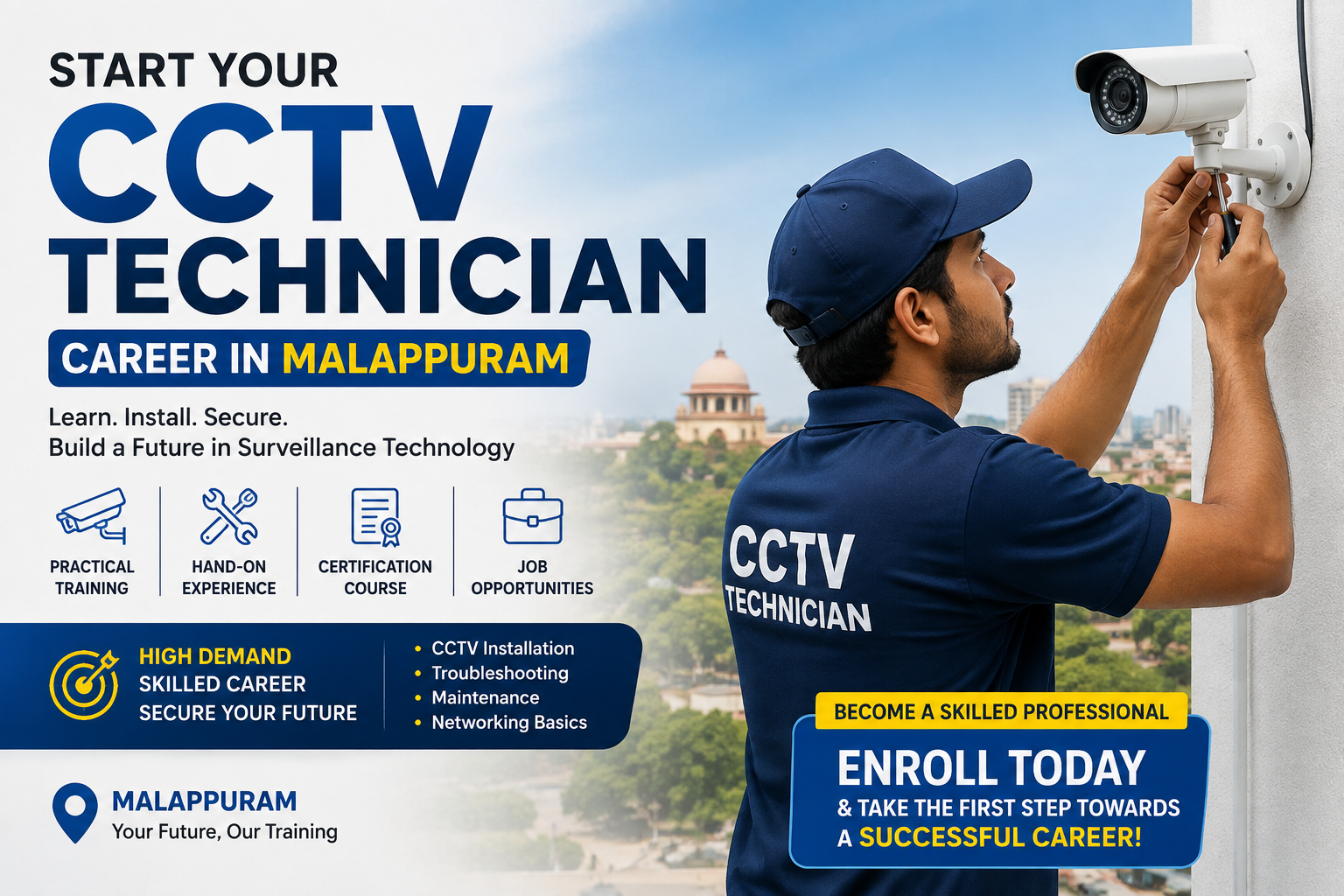

Security has become an important part of homes, shops, offices, schools, hospitals, warehouses and other commercial spaces. With the growing use of CCTV cameras and modern security systems, the demand for trained CCTV installation and service technicians is increasing across Kerala and other parts of India.
If you are looking for a CCTV Technician Course in Malappuram or a CCTV Technician Course in Kottakkal, choosing a practical and career-focused training program can help you develop the technical skills required for CCTV installation, configuration, troubleshooting and maintenance.
Kottakkal is one of the important commercial locations in Malappuram district and is accessible from several nearby towns. Local listings also show CCTV and security-system training opportunities in Kottakkal, including courses focused on practical training and service-centre exposure.
A CCTV Technician Course is a technical training program designed to teach students how to install, configure, maintain and troubleshoot CCTV surveillance systems.
A good CCTV technician needs more than basic knowledge of cameras. Technicians should understand different types of cameras, cables, power supplies, recording devices, networking, remote viewing and troubleshooting.
A practical CCTV course in Malappuram can introduce students to:
CCTV camera installation
DVR and NVR configuration
Camera wiring and cabling
Power supply connections
IP camera installation
Network configuration
Remote CCTV viewing
CCTV system maintenance
Camera troubleshooting
Basic networking
Security system installation
Preventive maintenance
The exact syllabus can vary between training institutes, so students should check the current curriculum before joining.
Malappuram has a large number of residential, commercial and business establishments where surveillance systems are commonly used. CCTV systems are important for monitoring entrances, shops, offices, warehouses, educational institutions and other properties.
For students from Malappuram and nearby areas, studying locally can be convenient and cost-effective compared with travelling to larger cities.
Searching for a CCTV Technician Course in Malappuram can be a good starting point for students who want to develop technical skills in electronic security systems.
Kottakkal is another convenient location for technical education in the Malappuram district. Local training listings specifically advertise CCTV installation and security-system training in Kottakkal.
If you are searching for a CCTV Technician Course in Kottakkal, look for an institute that provides practical training instead of focusing only on classroom theory.
CCTV installation is a hands-on technical job. Students should ideally get opportunities to work with actual cameras, DVRs, NVRs, cables, connectors, power supplies and networking equipment.
A practical training approach can help students understand how a CCTV system works from installation to final testing.
Important practical areas may include:
Students can learn how to select suitable camera locations, mount cameras correctly and connect the required cables and power supplies.
DVRs are commonly used with traditional CCTV systems, while NVRs are used with network/IP cameras. Understanding their configuration is an important part of CCTV technician training.
Proper cabling is essential for reliable surveillance. Training can cover coaxial cables, network cables, connectors and cable testing.
Modern CCTV systems increasingly use network-based cameras. Students can learn basic IP addressing, network connections and camera configuration.
Many customers want to monitor their CCTV cameras through smartphones or computers. Students can learn the basic process involved in connecting compatible CCTV systems to networks and configuring remote access.
A professional technician should be able to identify common problems such as:
No camera display
Poor image quality
Camera offline
Power failure
Cable problems
Network connection issues
DVR/NVR recording problems
Remote viewing problems
Storage-related issues
Practical troubleshooting experience can be particularly valuable when starting a career as a CCTV technician.
The syllabus depends on the institute, but a comprehensive course may cover the following areas:
CCTV Basics:
Understanding surveillance systems, camera types and basic security concepts.
Camera Types:
Learning about different CCTV cameras, including analog, HD and IP cameras.
DVR/NVR:
Understanding recording devices, storage configuration and basic system settings.
Cabling:
Learning cable selection, termination, connections and testing.
Power Supply:
Understanding suitable power requirements and safe connections.
Networking:
Learning basic networking concepts required for IP CCTV systems.
Installation:
Practical camera mounting, cable routing and system configuration.
Troubleshooting:
Identifying and resolving common CCTV installation and connectivity problems.
Maintenance:
Understanding routine inspection and maintenance procedures.
When selecting the best CCTV Technician Course in Malappuram, practical training should be one of the most important factors.
Reading about CCTV installation is not enough to become a professional technician. Students need practical experience with real equipment.
A practical course can help students understand:
How to install a camera
How to terminate cables
How to configure a DVR
How to configure an NVR
How to connect an IP camera
How to test cables
How to identify power issues
How to troubleshoot camera problems
How to configure basic network settings
Some Kottakkal course listings specifically promote practical CCTV training and service-centre training after course completion.
CCTV technician training can be suitable for people who are interested in technical and security-system work.
It may be useful for:
Students after school education
Plus Two students
Job seekers
Electrical technicians
Electronics technicians
IT and networking beginners
Mobile and computer technicians
Entrepreneurs
Existing CCTV installers
People interested in starting a security-system business
The eligibility requirements vary depending on the training provider.
After developing the necessary practical skills, students can explore different career paths in the security and surveillance industry.
Possible roles include:
CCTV installation technicians install cameras, recording devices, cables and related equipment at residential and commercial locations.
Service technicians inspect CCTV systems and troubleshoot problems reported by customers.
Technicians may work with CCTV along with other security technologies such as access control, alarms and related systems.
Large businesses and institutions may require regular inspection and maintenance of surveillance systems.
Experienced installers can work independently or with security-system companies.
After gaining sufficient technical experience, some professionals may choose to start their own CCTV installation and service business.
CCTV and security-system skills can be useful in several industries, including:
Security companies
CCTV installation companies
IT companies
Electrical companies
Commercial establishments
Shopping centres
Hotels
Hospitals
Schools and colleges
Warehouses
Residential projects
Students interested in working outside Kerala should research the specific technical requirements, certifications and employment regulations applicable to the destination country.
Before joining a CCTV training institute, compare the following factors:
Check whether the course provides hands-on training using real CCTV equipment.
Modern CCTV systems increasingly use IP cameras and networking, so the syllabus should cover relevant technologies.
Experienced instructors can help students understand real-world installation and troubleshooting problems.
Ask whether students will get practical access to cameras, DVRs, NVRs, cables and networking equipment.
Practical service-centre exposure can help students understand how CCTV systems are handled in real customer environments.
Check what certificate is provided after completing the course and whether the issuing organisation is clearly identified.
If an institute offers placement or career assistance, ask for clear details about what is actually included.
The security industry is becoming increasingly technology-driven. CCTV cameras are now used in many different environments, creating opportunities for people with practical installation and troubleshooting skills.
For students searching for a CCTV Technician Course in Malappuram, Kottakkal can be a convenient location to explore technical training opportunities. The local market already has listings for CCTV installation and security-system training.
Instead of choosing a course based only on advertisements, compare the practical syllabus, training equipment, trainer experience, certification and career support before making your decision.
A CCTV Technician Course in Malappuram can be a useful option for students and job seekers interested in electronics, networking and security technology. A properly structured course can provide knowledge of CCTV cameras, DVR/NVR systems, cabling, networking, installation, configuration and troubleshooting.
If you are specifically searching for a CCTV Technician Course in Kottakkal, focus on institutes that provide practical equipment-based training and opportunities to understand real installation and service procedures.
With continuous learning and practical experience, CCTV technicians can explore opportunities in installation, maintenance, service, security systems and independent business.
1. What is a CCTV Technician Course?
It is a technical training program covering CCTV installation, configuration, maintenance and troubleshooting.
2. Where can I study a CCTV Technician Course in Malappuram?
Students can explore training providers in Malappuram and nearby locations such as Kottakkal. Current local listings include CCTV installation training opportunities in Kottakkal.
3. Is practical training important for CCTV technicians?
Yes. Practical experience with cameras, DVRs, NVRs, cables and networking equipment can help students develop real-world technical skills.
4. Can I start a CCTV installation business after training?
With sufficient technical knowledge, practical experience and the necessary business setup, CCTV installation and service can be a potential self-employment option.
5. What should I check before joining a CCTV course?
Check the syllabus, practical classes, equipment, trainer experience, certification, course duration, fees and career support before enrolling.